
Send a Prompt and Multiple Images to Get an Answer (ChatGPT)
Use this action to send multiple images or files stored in Jestor — along with a written prompt — to OpenAI's ChatGPT and save the AI-generated response directly into a record field. It is useful for automating visual analysis, content generation from images, and data extraction workflows that involve more than one visual input.
When to Use
- Automatically extract and cross-reference data from multiple documents, invoices, or receipts uploaded as images in the same record
- Compare or analyze multiple photos attached to a record and generate a unified summary
- Classify or describe the combined content of several images stored across different fields
- Combine multiple visual inputs with a written instruction to produce structured or formatted output
How to Configure
Step 1 — Create a new automation
This page covers only the Send a prompt and multiple images to get an answer (ChatGPT) action. For instructions on how to access automations and create a new automation, see the Automations page.
Step 2 — Set the trigger
Under When, select your trigger. For this example, select When a new record is created.
Step 3 — Add the ChatGPT action
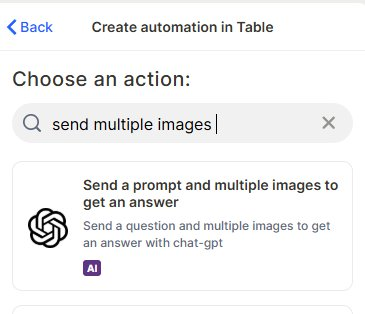
Under Do, click + Add action. In the search bar, type send multiple images and select Send a prompt and multiple images to get an answer.
Step 4 — Connect your OpenAI account
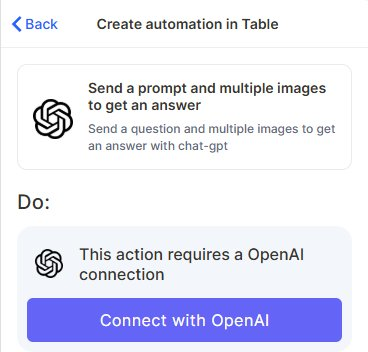
The action requires an OpenAI connection. Click Connect with OpenAI and complete the authentication flow. This only needs to be done once per workspace.
Step 5 — Choose tab
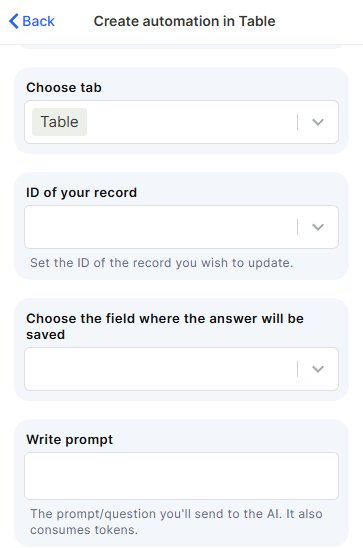
In the Choose tab dropdown, select the table whose record you want to update with the AI response. This is usually the same table where the automation lives.
Step 6 — ID of your record
In the ID of your record field, select the field that holds the record's ID. This tells Jestor which record to write the response to.
Step 7 — Choose the field where the answer will be saved
Select the field in your table where ChatGPT's response will be stored. This field must already exist in the table — the automation will not create it automatically. Use a Long Text field for most use cases.
Step 8 — Write prompt
Write the prompt you want to send to ChatGPT alongside the images. You can reference field values from the current record using dynamic variables. Be specific — the quality of the prompt directly affects the quality of the response. The prompt also consumes tokens.
Step 9 — Images (optional)
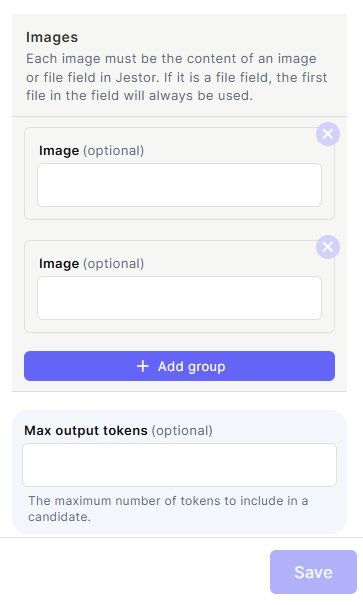
Map the image or file fields that contain the visuals you want to send to ChatGPT. Each slot corresponds to one image or file. The input must be the content of an image field or a file field in Jestor — if the field holds multiple files, the first file will always be used. Click + Add group to include additional images or files.
Step 10 (optional) — Max output tokens
Set a limit on the length of the response. If left empty, the model will use its default limit.
Step 11 — Save
Click Save to finalize the action, then Create to activate the automation.
Keep in Mind
- The response is saved directly to the field — there is no preview or approval step before the content is written.
- This action does not create records — it only updates an existing field in an existing record. If you need to create a record with the response, combine this action with a Create record action.
- Always use Jestor's dynamic variable selector to insert field references into the prompt. Typing the variable name manually may cause validation errors if the name doesn't match the field exactly.
- The action does not return structured data automatically — if you need JSON or a specific format, instruct the model in your prompt and parse the output separately.
- The action does not support multi-turn conversations — it sends one prompt with all images and receives one combined response. There is no memory of previous runs.
- If a field contains multiple files, only the first file is sent to ChatGPT — the remaining files are ignored.
FAQ
1 — Does this action work with any trigger, or only "When a new record is created"?
It works with any trigger. The When a new record is created trigger is used as an example in this guide. You can use it with When a field is updated, scheduled triggers, and others.
2 — How is this different from the "Send a Prompt and an Image to Get an Answer" action?
The single-image action processes only one image per run. This action lets you map multiple image or file fields and send them all in a single prompt, allowing ChatGPT to analyze them together and return one combined response.
3 — Can I send just one image using this action?
Yes. You can add only one image slot. However, if you only need to send a single image, the Send a Prompt and an Image to Get an Answer action is simpler to configure.
4 — Can I use a dynamic value inside the prompt field?
Yes. You can reference field values from the triggering record inside the prompt — for example, including a record's name or category as part of the instruction sent to the AI alongside the images.
5 — Does this action work with files that are not images?
Yes. Each input can come from an image field or a file field in Jestor. If the field holds multiple files, only the first file will be used.
6 — What happens if I leave the Max output tokens field blank?
ChatGPT will use its default token limit for the response. Set a value only if you need to control the length of the output, such as limiting to short summaries.
Updated 7 months ago