
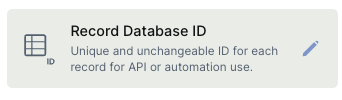
Record Database ID
The Record Database ID field displays a unique, permanent numeric identifier automatically assigned to each record. It cannot be edited or duplicated across records, making it a reliable reference for automations, API calls, and external integrations.
For instructions on how to access field types or how to add one, see Field Types.
Capabilities
- Displays a unique integer ID for every record in the table
- IDs are permanent and never reused, even if the record is deleted
- Available as a reference in automations and API requests
- Supports filtering and sorting
Use cases and examples
Use the Record Database ID when you need a stable, unique reference to a record — for example, passing a record's ID to an external system via API, using it as a key in an automation trigger, or ensuring data traceability across integrations. It is also useful when debugging automations, since each record can be pinpointed precisely by its ID.
Keep in mind
- The ID is assigned automatically and cannot be set or changed manually
- It does not reflect the order in which records appear in a view — it reflects the order they were created
- Deleting a record permanently removes its ID; that number is never reassigned to another record
- The field cannot be used as a relation or lookup source
FAQ
1- Can I change the value of a Record Database ID?
No. The ID is generated automatically by Jestor and is immutable. There is no way to edit or reset it.
2- Is the Record Database ID the same as the row number shown in the table?
No. The row number shown in table view reflects the current sort order of the view, while the Database ID is a fixed internal identifier that never changes regardless of how records are sorted or filtered.
3- Can I use the Record Database ID in automations?
Yes. The ID is available as a field value in automation triggers and actions, making it ideal for referencing specific records in external systems or chained automations.
4- Will IDs stay sequential if I delete records?
No. If a record is deleted, its ID is gone permanently. New records will continue incrementing from the highest existing ID, so there may be gaps in the sequence.
Updated 6 months ago